Sunday, 30 December 2007

Still Waiting

El Espectador is the main paper in Bogotá, the capital of Colombia. This tidbit updates recent developments in the rescue mission.

http://www.elespectador.com/elespectador/Secciones/Detalles.aspx?idNoticia=19828&idSeccion=18

Everything ready to Retrieve Hostages
Sunday, December 30, 2007

The Colombian government authorized Venezuela to send a Falcon aircraft carrying the Venezuelan Minister of the Interior, Ramón Rodríguez Chacín--the coordinator of the operation--into Colombia.

Venezuela also requested permission to send two Bell helicopters.

The Commissioner of Peace, Luis Carlos Restrepo, said Rodríguez will have an open route into Colombia to oversee the release of the hostages and that the Uribe administration will guarantee the security of the drop-off zone.

Restrepo claims the Venezuelan statesman will be the one receiving the coordinates sent by FARC [Revolutionary Armed Forces of Colombia]. Rodríguez will then send them to the International Red Cross Committee (CIRC), thus initiating the Colombian operation to retrieve the hostages.

Restrepo clarified that the coordinates will not be revealed to the Colombian government, as they will be used exclusively for the humanitarian operation.

Initially, two helicopters were going to retrieve the hostages and return them to Villavicencio [Colombia]. However, the International Red Cross Committee and the Venezuelan Minister of the Interior will decide if the hostages will be carried into Venezuelan territory to secure their freedom.

Restrepo claims the Colombian government has not yet set terms for carrying out the operation, even when the 72-hour permissions have been issued for the Venezuelan airships. “This permission does not limit the operation,” he claimed.


Picture: Chávez and the Ex-Kirchner. Buddy buddies?


All errors and interpretations are mine. Who edits anyway?

Friday, 28 December 2007

The Chávez Way

This article offers a Colombian view on the hostage release now underway. The notable exchange involves seven countries, including France and Switzerland. If for nothing other than politics, the deal appears to show a significant realignment of regional interests along the “Chávez” way, the showman of this latest Latin maneuver. We’ll have to wait and see how things turn out…

El Colombiano, from Medellín, Colombia
http://www.elcolombiano.com.co/BancoConocimiento/O/olac_chavez_llego_a_tachira_liberacion_clara_lcg_28122007/olac_chavez_llego_a_tachira_liberacion_clara_lcg_28122007.asp?CodSeccion=53

Clara, Emmanuel and Consuelo Very Close to Freedom

Santo Domingo, Venezuela
5:00 PM Central Standard Time


This Friday the operation to retrieve three hostages, who will be released by the FARC, got under way with the departure of two helicopters to Colombia, leaving from the Santo Domingo airport in the Venezuelan state of Táchira.

“The operation began with those two helicopters (…) and we’re able to say this was the first phase, to approach the objective. The second is the rescue” of the three hostages held by the Revolutionary Armed Forces of Colombia (FARC), declared Venezuelan president Hugo Chávez after the airships departed.

The two MI-17 helicopters, however, left without the seven presidential emissaries. Caracas claims this was to guarantee “the security and transparency” of the humanitarian operation. The helicopters were painted black and orange with the symbol of the International Red Cross.

“We hope by tomorrow we’ll be able to complete the mission” and begin the search for the three hostages in the Colombian jungle. The FARC announced their release last week, said Chávez. This will be the release of ex-vice-presidential candidate Clara Rojas, her son Emmanuel, born in captivity, and ex-congresswoman Consuelo González de Perdomo.

Details
In military uniform, Chávez dispatched the Russian-designed airships, heading from the Major Buenaventura Vivas Guerrero Airbase, near the Colombian border, toward Villavicencio [Colombia].

A few minutes later, the president announced the two helicopters had crossed into Colombian territory. This was the first phase of the undertaking renamed “Operation Emmanuel” by Caracas, even though initially entitled “Operation Transparency.”

Chávez stated the guerrilla group still has not given the exact location where helicopters will retrieve the three hostages because, according to Chávez, there are difficulties with “communications.” Due to this, emissaries from Argentina, Bolivia, Brazil, Cuba, Ecuador, France and Switzerland will be brought to Villavicencio when the coordinates are known.

Traveling with the international delegates will be the coordinator of the operation, former Minister of the Interior Ramón Rodríguez Chacín, as well as the High Commissioner of La Paz, Luis Carlos Restrepo, both representing Colombia.

Good weather
“The only remaining part is to ask God for good weather so the operation will run smoothly and successfully,” requested President Hugo Chávez while presenting his “formula” for freeing Clara Rojas, her son Emmanuel and the former congresswoman Consuelo González de Perdomo. Chávez gave the presentation last Wednesday in the Miraflores Palace.

As if God had been listening, fair weather accompanied the departure of the two MI-17 helicopters. These airships carried the symbol of the Red Cross when they departed west for Villavicencio, their first stop.

There is hope that today and tomorrow the eastern Colombian skies will bless the humanitarian effort. At the least the Institute of Hydrology, Meteorology and Environmental Studies (IDEAM) anticipates a dry spell for the region in this last weekend of the year.

According to the IDEAM, the sky will remain partially cloudy in the north and central Orinoquía [eastern region of Colombia] with rains in the northeast region of Vichada, in Guainía [southern part of Orinoquía] in Arauca [northern part of Orinoquía] and in the southern part of Colombia, east of the Amazon.

With this report, the aerial caravan will cross into the eastern regions of the Colombian jungle, toward where the three hostages, held by FARC guerrillas, are presumed to be waiting.

Thursday, 27 December 2007

Argentine Foreign Policy Realigns with Madame Kirchner

http://www.lanacion.com.ar/politica/nota.asp?nota_id=974305&pid=3723146&toi=5258

A new gesture to Chávez
Ex-President Kirchner travels to Colombia amid new criticisms of the United States

The ex-president Kirchner left in the Tango 01 to participate in the release of the FARC hostages; Alberto Fernández [Chief of Staff, Kirchner Administration] again links the Antonini scandal [see below, 12/15/07] with the Argentine role in the freeing of hostages.

Thursday, December 27, 2007

With expectations climbing on the release of three FARC hostages [Revolutionary Armed Forces of Colombia, guerrilla], ex-president Néstor Kirchner and Foreign Minister Jorge Taiana departed today. The flight left the military base Aeroparque en route to Colombia, where the ex-president will be one of several advocates selected by [President] Hugo Chávez for the release of hostages.

This will be the first official assignment for ex-president Kirchner and, with his announcement yesterday afternoon, marks a new balance between his wife’s government [President Cristina Kirchner] and the Venezuelan leader.

“We depart with much hope and optimism. Soon we’ll meet with the Venezuelan authorities to organize the operation,” affirmed Foreign Minister Taiana before departing this afternoon. They hope to arrive in Caracas tonight and, according to the arrangement between the Venezuelan government and the Red Cross, they will be given more details so the hostage release can take place.

“The exact conditions of the operation cannot be determined. Yesterday the weather in the region was bad, for example,” detailed Foreign Minister Taiana.

“We are looking to guarantee the peaceful release of these people and that this liberation will be the first among many,” clarified Taiana.

Another attack. Meanwhile the Chief of Staff Alberto Fernández was ordered to strength criticism of the United States. Fernández again linked the proceedings of the suitcase scandal in the U.S. justice department with the foreign policy of the President, in particular her proximity to Chávez and the explicit collaboration regarding the release of the FARC hostages.

Even though he began by avoiding these topics, Fernández eventually reinforced the premise of the Casa Rosada [Pink House, the equivalent of the White House in Argentina] versus Washington.

“At this moment, it doesn’t make much sense to continue this conversation, especially when we’re working toward the release of three people who for years have been deprived of their freedom,” opened Fernández on Radio 10.

Support. Immediately after, Fernández claimed, “What I’m saying is that we created this opposition when we saw the posture of the United States on the case of Antonini Wilson. This reaction was derived from a series of things: the Banco del Sur, our relationship with Venezuela, as well as President Kirchner’s speech when she committed herself to the Ingrid Betancourt cause, as well as collaborating in her release.”

Fernández continued, “We all know the interest the United States has in combating the Colombian guerrillas, the Plan Colombia. It seems to me this plan has a certain logic, otherwise it’s difficult to understand the reaction and the arguments of the U.S. Secretary of Justice.”

What is more, Fernández reiterated that the United States “was wrong” in their interpretation of Antonini’s illegal entrance into Argentina with almost 800,000 US dollars.

“What I would like the most is a pan-American justice which acts independently and seeks to verify a reality. If we have that, the U.S. will realize the error they’re committing,” Fernández claimed.

Also, President Cristina Kirchner approved a public message to reinforce her defense of “multilateralism” and of regional cooperation. However, she avoided any mention of the Antonini case or the release of hostages held by FARC.

Release Plan. Kirchner, together with Foreign Minister Taiana, will travel to the city of Caracas. From there another plane will carry them to Villavicencio, the capital of the department of Meta [Colombia], where they’ll meet with other advocates, Venezuelan government officials and members of the International Red Cross.

The details of the jungle trek remain in the strictest silence--this will assure the safety of the hostages and guarantee the operation’s success.

Once in Villavicencio, Kirchner and the Foreign Minister will enter the Colombian jungle to witness the release of three guerrilla hostages: the ex-vice-presidential candidate Clara Rojas, her son Emmanuel, born in captivity some four years ago, and the ex-congresswoman Consuelo González.

The only ex-president. Including Argentina, the countries of Brazil, Ecuador, Cuba, Bolivia and France, along with Venezuela, will send representatives.

In any case, Argentina will send the most prominent national figure. While the rest of the countries are sending ambassadors to Caracas or their principal adviser on foreign affairs, Argentina is the only country summoned by Chávez to send an ex-president who left power only 17 days ago.

Under U.S. scrutiny. The rescue of the FARC hostages, in which Argentina has a primary role, will be carried out amid particular tension in the bilateral relations with Washington.

The link with Washington remains decisively weakened, given that President Kirchner accused the United State of orchestrating, through the investigation of the suitcase scandal in Miami, a “Trash Operation” against her government [see 12/15/07].

From her oath of office, Cristina Fernández has made her interests clear. She invited the mother of Ingrid Betancourt, Yolanda Pulecio, to the ceremony. Betancourt was a Colombian presidential candidate sequestered by the FARC almost six years ago.

A few days before leaving power, the ex-president Néstor Kirchner received a letter from the President of France, Nicolás Sarkozy, asking for his “support” in freeing Betancourt, who is also a French national.

The White House, for its part, looks with distrust on the Argentine proximity to Chávez and its active participation in freeing Columbian guerrilla hostages.

All errors and interpretations are mine. Please comment.

Monday, 24 December 2007

FARC and Regional News

This article shows the complex international relations involved in combating the recent guerrilla movement in Latin America. Although regarding the Colombian guerrillas, FARC, the article appears in the Peruvian press. A similar neo-marxist (though Maoist) revolutionary movement continues in Peru, self-titled the Shining Path (Sendero Luminoso). Without much effort, an image of the guerrilla movement in Latin America can be formed from the late 1960s, perhaps all the way to Cuba and Che Guevara in 1958--hostages, crime, revolutionary ideology and an erosion of the state’s monopoly on violence. This forms part of regional, rather than national, news.

http://www.larepublica.com.pe/content/view/195521/676/
La República--Perú

The Wait Continues for the Release of Three Hostages Held by Guerrilla

Sunday, December 23, 2007

(10:22 PM) The awaited release of three hostages held by the Revolutionary Armed Forces of Columbia (FARC) continues today with confidence, as the guerrilla could fulfill their announcement somewhere between Venezuela, Colombia and Brazil.

The released hostages would be Clara Rojas [vice-president candidate in the 2002 presidential elections in Colombia], her son Emmanuel and the ex-congresswoman Consuelo González de Perdomo. These three have been held by the FARC since 2002, when they were captured in two separate raids. Emmanuel, three years old, was born in captivity—the result of relations between Rojas and a common guerrilla.

For the families of these hostages, there is confidence the FARC will fulfill their announcement, given that President Chávez [Venezuela] claimed parts of the Colombian government do not want this result.

From Caracas [Venezuela] on Saturday, the Columbian senator Piedad Córdoba anticipates a “signal” from President Chavez regarding the FARC announcement to free hostages. Senator Córdoba and President Chávez were mediators between the Colombian government and the FARC, searching for an acceptable exchange of hostages. However, President Álvaro Uribe [Colombia] ended this role last November 21.

For the mother of Clara rojas, Clara González de Rojas, the freedom of her daughter and grandson would be “the best Christmas present that God could give us after so much suffering.” Close friends of the family say they are waiting with a traditional Christmas dinner, natilla and buñuelos [small fritter and custard], because they are confident the release will happen on Christmas Eve.

As far as the captured congresswoman Consuelo González, everything is ready for her return to a farm located near the municipality of Pitalito, in Huiloa [south central Colombia]. Her daughters, Patricia Helena and María Fernando, will recount everything that has changed since her absence. What is more, Colombian president Álvaro Uribe claimed last Friday, “we will be waiting on Christmas Eve, waiting for the release of these hostages. Let us pray! Let us pray they are found; this is what we want."

The FARC have in their control 45 politicians, soldiers, police officers, three U.S. citizens and the ex presidential candidate Ingrid Betancourt, also a French nationalist, which they hope to exchange for 500 imprisoned guerrilla. For the exchange, the rebels demand an end to martial law in the municipalities of Pradera and Florida, in Valle del Cauca (southeast Colombia). However, Uribe will not accept this deal for reasons of sovereignty and security.
(EFE—Bogotá)

Friday, 21 December 2007

Old Warriors and Cold Wars

The heyday of the Argentine Página 12 came in the early 1980s, revealing the atrocities of the Last Argentine Dictatorship while supporting the Mothers of the Plaza de Mayo. The notable leftist publication has since receded into a more glib, lefty position on local as well as global events.

Here the notable Argentine poet and early 1970s guerrillero Juán Gelman comments on the 2007 Nobel Peace Prize and the environment. Or, more accurately, attempts to defrock a secret Pentagon research project. Yet in English he sounds more like the narrator of The Outer Limits. The interesting part is the way this theme--the U.S. as an omnipotent superpower--develops itself into a mystical fear of U.S. aggression abroad: one with no real solution or response. This is coming from a man who briefly dedicated his life to overthrowing pax americana.

La Prensa
http://www.pagina12.com.ar/diario/contratapa/index-2007-12-20.html


On the Climate War
Juán Gelman

The 2007 Nobel Peace Prize was shared, as is well-known, between Al Gore and the Intergovernmental Panel on Climate Change (IPCC). It is remarkable that neither the former vice-president’s speech nor the report of the IPCC prizewinners mention weapons designed to manipulate the climate, which the U.S. has developed for more than half a century. Russia and Europe have also started down that path.

This is a topic that rarely appears in discussions and/or research concerning global warming or the greenhouse effect that the planet suffers. In the most recent report concerning alternative defense methods, the U.S. Air Force remarked that at the end of the 1940s, with the Cold War hotter than ever, the Pentagon was already researching ways to produce “unimaginable forms of climate war.” This entailed a technology Washington continues to perfect through the High Frequency Active Auroral Research Program (HAARP) established in 1992. This is not a joke.

The aims declared by HAARP are innocent enough--science--yet the primary goal seems to be a weapon of mass destruction, capable of destabilizing the global ecological balance. The press release even states this, “Climate modification will form part of national and international security, which this technology could achieve unilaterally. Modifying the climate allows us to defeat or slow down an adversary. This will be relevant in offensive as well as defensive scenarios, including use as a deterrent. The (military) technology is capable of generating rain, snow and storms on land as well as producing an artificial climate.”

In Gakona, Alaska, the Air Force, the Marines and the Defense Advanced Research Projects Agency (DARPA) have installed 180 antennas that function like one giant antenna, capable of emitting up to one billion high frequency radio waves. These waves introduce an enormous mass of energy into the ionosphere, or uppermost part of the atmosphere, which return to the surface causing the temperature to increase. In this way, it is possible to induce a change in the ionosphere, altering the climate of a selected region with disastrous consequences: excessive rain, flooding, a multiplication of hurricanes, prolonged droughts, earthquakes, disruptions in the electric and communication grids, accidents in the gas and oil pipelines, etc. Will this be a geophysical weapon? The official website reads “HAARP is a scientific endeavor designed to study the properties and behavior of the ionosphere with particular attention to how this region may improve communication and surveillance systems. These include civil ends, such as those regarding defense.” [Apologies, this is a re-translation as Gelman took liberties interpreting the website, http://www.haarp.alaska.edu/haarp/prpeis.html]

The Canadian economist Michel Chossudovsky indicates climate manipulation would allow the U.S. to dominate entire regions, “It would be the preventative weapon par excellence. The U.S. could deploy the weapon against enemy countries or “enemy nations” without their knowledge. This would destabilize their economies, ecosystems and agriculture as well as devastate the financial and commercial markets. A destabilized agriculture creates a greater dependency on food subsidies and importing U.S. and Western grain. What is more: the effects may be serious for the brain as well as human behavior.

The Pentagon made public for the first time the use of climate warfare in 1974: for seven years this technology concentrated clouds over Vietnam and Cambodia, increasing rains in selected regions, provoking mudslides and making the roadways used by Hanoi to send provisions to the Vietcong impassable. By 1977, these developments drove the General Assembly of the UN to approve a convention prohibiting “the military use of weather altering techniques causing extreme, general and prolonged effects.” This premise was later incorporated into the 1992 UN convention on climactic change held in Rio de Janeiro. However, the topic has converted into a type of taboo. Although the existence of these weapons is tacitly accepted, the debates in the UN focus on the Tokyo Protocol that the U.S. rejected. [In English] The rest is silence.


All errors and interpretations are mine. Please comment.

Wednesday, 19 December 2007

A stereotype anyone? Latin American drug runners…

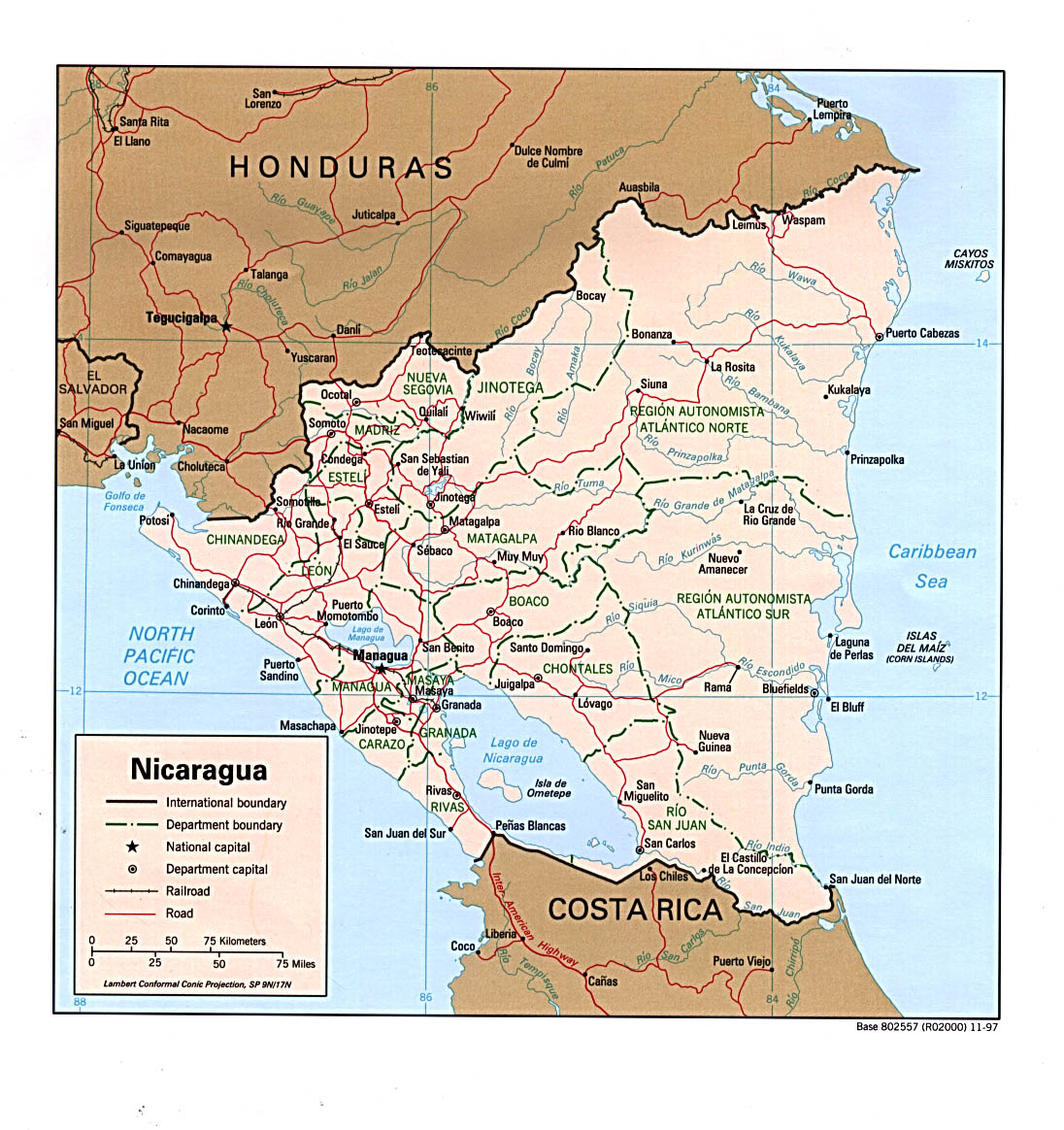
Hey, who knew? There is an archipelago of autonomous islands off the northeast coast of Nicaragua (where the Miskitos Wharf is located)—only a five-hour boat ride from Managua, the capital. See http://www.lib.utexas.edu/maps/americas/nicaragua_pol_97.jpg.

This newsbit was taken from La Prensa, one of several Nicaraguan newspapers. Following the translation is the original text.
http://www.laprensa.com.ni/archivo/2007/diciembre/19/noticias/ultimahora/233704.shtml

In Miskitos Wharf authorities capture speedboat laden with drugs

December 19, 2007
This afternoon Naval authorities captured a speedboat laden with an unknown amount of drugs in the Miskitos Wharf, part of the North Atlantic Autonomous Region [RAAN, off the Northeast coast of Nicaragua].

According to a military press release, the craft “Eduardoño” was captured at 3:30 this afternoon northeast of Bilwi by four Naval speedboats. The Nicaraguan Navy coordinated their response with the U.S. Coast Guard.

On the speedboat various sacks were found, filled with drug packets presumed to be cocaine. At this moment the quantity is unknown.

“The operation called Safe Caribbean has developed through bilateral agreements between the Nicaraguan and U.S. governments, seeking to reduce air and sea drug trafficking. The Air Force located the speedboat, forcing the craft to run aground. The traffickers abandoned their craft and remain at large,” indicated the press release.

[I need an editor...]

Capturan lancha rápida con droga en Cayos Miskitos

Una lancha rápida con una carga de droga que aún no ha sido cuantificada, fue capturada esta tarde en el sector de los Cayos Miskitos, por tropas de la Fuerza Naval, desplegadas en la Región Autónoma del Atlántico Norte (RAAN), informó hoy el Ejército de Nicaragua.
Según un comunicado de la institución castrense, la embarcación tipo "Eduardoño", con tres motores fuera de borda, fue capturada a las 3:30 de la tarde en el sector de los Cayos Miskitos, al noreste de Bilwi, por cuatro lanchas rápidas de la Fuerza Naval, en coordinación con el Servicio de Guarda Costas de los Estados Unidos de América.
En la embarcación, de matricula o nacionalidad desconocida, fueron encontrados varios sacos con paquetes de droga, presuntamente cocaína, aunque hasta el momento se desconoce la cantidad incautada."El operativo denominado Caribe Seguro, desarrollado en el marco de los acuerdos suscritos entre los gobiernos de Nicaragua y Estados Unidos de América, para suprimir el tráfico de droga por mar y aire, involucró la participación de un medio aéreo el cual localizó a la lancha capturada, la que fue obligada a vararse en un cayo donde los tripulantes se dieron a la fuga abandonando dicha embarcación, los que están siendo buscados para su captura", indicó la nota de prensa.

Monday, 17 December 2007

Chávez Opposition Opposes Chávez

From Globovisión.com
http://www.globovision.com/news.php?nid=74081
The only opposition media still operating in Venezuela, Globovisión offers an almost constant critique of popular president Hugo Chávez. This tidbit emphasizes the role Chávez played in the “escándolo de la valija” [suitcase scandal] surrounding the Argentine presidential elections earlier this November.

Venezuela and Argentina agreed to cover up the suitcase scandal, according to the Miami federal prosecutor.

A Miami federal prosecutor confirmed the existence of recordings on Monday that reveal an agreement between Argentine and Venezuela governments in August, claimed El Nuevo Herald. Organized in Buenos Aires, this agreement covers up the origin and destination of money confiscated from the Venezuelan-American businessman Guido Antonini Wilson.

“There are many recordings where [the accused] leaves it very clear that the Argentine and Venezuelan governments had made a deal. Both agreed to suppress the true source of the funds and make any problem disappear as long as Antonini collaborates,” affirms the prosecutor Tom Mulvihill.

Mulvihill’s declaration was taken word for word by El Nuevo Herald from a court recording. In the same session, Mulvihill ensured that the Venezuelan government offered $2 million US dollars for Antonini’s silence.

Related News:-Chávez says the detention of Venezuelans in the U.S. is a disgrace to pressure the President of Argentina.
- The Uruguayan Chancellor reiterated that the luggage scandal is “astonishing”
- Venezuelans offered Antonini $2 million US dollars to remain silent, reveals the federal prosecutor